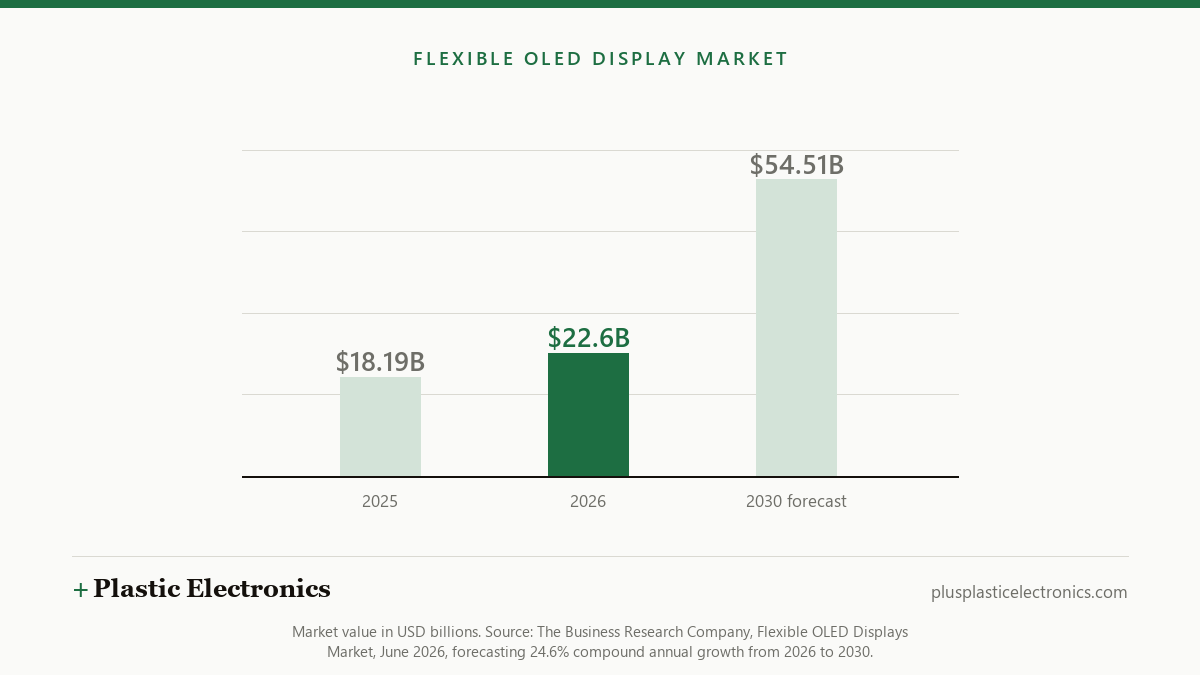
For most of the 2010s, flexible OLED was a trade-show story: beautiful concept panels, cautious pilot lines, and a manufacturing yield problem that ate every margin forecast. That chapter is closed. The Business Research Company puts the flexible OLED display market at $22.6 billion in 2026, up from $18.19 billion in 2025, with compound annual growth of 24.6% carrying it to $54.51 billion by 2030.
The shift did not come from one breakthrough. It came from accumulation: foldable smartphones passed their third generation with acceptable crease behaviour and durable ultra-thin glass covers; panel makers converted rigid lines to flexible backplanes; and — critically — buyers stopped treating flexibility as a gimmick and started specifying it for products where the display must survive bending, folding or conforming to a curved surface.
What changed between demo and deployment
Three gates had to clear before flexible OLED could ship at volume. First, encapsulation: thin-film barrier layers finally reached the water-vapour transmission rates that keep organic emitters alive for years, not weeks. Second, cover materials: ultra-thin glass and hybrid film stacks solved the scratch-versus-fold trade-off that doomed first-generation foldables. Third, test and repair economics: panel makers learned to harvest flexible panels at yields that make the cost-per-good-panel arithmetic work.
Where the next doubling comes from
Smartphones remain the anchor, but analysts tracking design-in activity point to four volume drivers through 2030:
- Foldable slates and laptops — larger panels, higher ASPs per square metre, and enterprise demand for carry-compact/work-large form factors.
- Automotive interiors — pillar-to-pillar curved dashboards and flexible OLED lighting surfaces, where conformal geometry is not decoration but a packaging requirement.
- Wearables and XR — high-brightness, low-power flexible panels in forms rigid glass cannot serve.
- Rollable and slideable TV — still a luxury niche, but one that pulls the whole supply chain toward ever-thinner stacks.
The question is no longer whether flexible OLED can be manufactured. It is how fast the rest of the product world can redesign around what the panel now permits.
The India angle
India's display ambitions add a fresh subplot. As domestic electronics assembly deepens into components, flexible panel demand from Indian device makers is rising, and suppliers of materials, test equipment and module assembly are watching the subcontinent as a growth market distinct from China-centric volumes. For a publication that has tracked this industry since polymer-backplane days, that broadening of the buyer base — from three handset giants to a global, multi-vertical spread — is the real story of 2026.
By the numbers
- $22.6B
- Flexible OLED display market value in 2026, up from $18.19B in 2025
- 24.6%
- Forecast CAGR for flexible OLED displays, 2026–2030
- $54.51B
- Forecast market value in 2030 (The Business Research Company, June 2026)
The caveat every reader of market forecasts already knows: CAGR curves smooth over capacity cycles. Display history is a story of over-investment, price collapse and consolidation, repeated roughly once a decade. Flexible lines are expensive, and the tooling bills now landing will test whether demand growth can outrun the capacity being built to serve it. But even the pessimistic scenarios no longer question whether flexible OLED is mainstream — only how brutal the pricing becomes on the way to $54 billion.