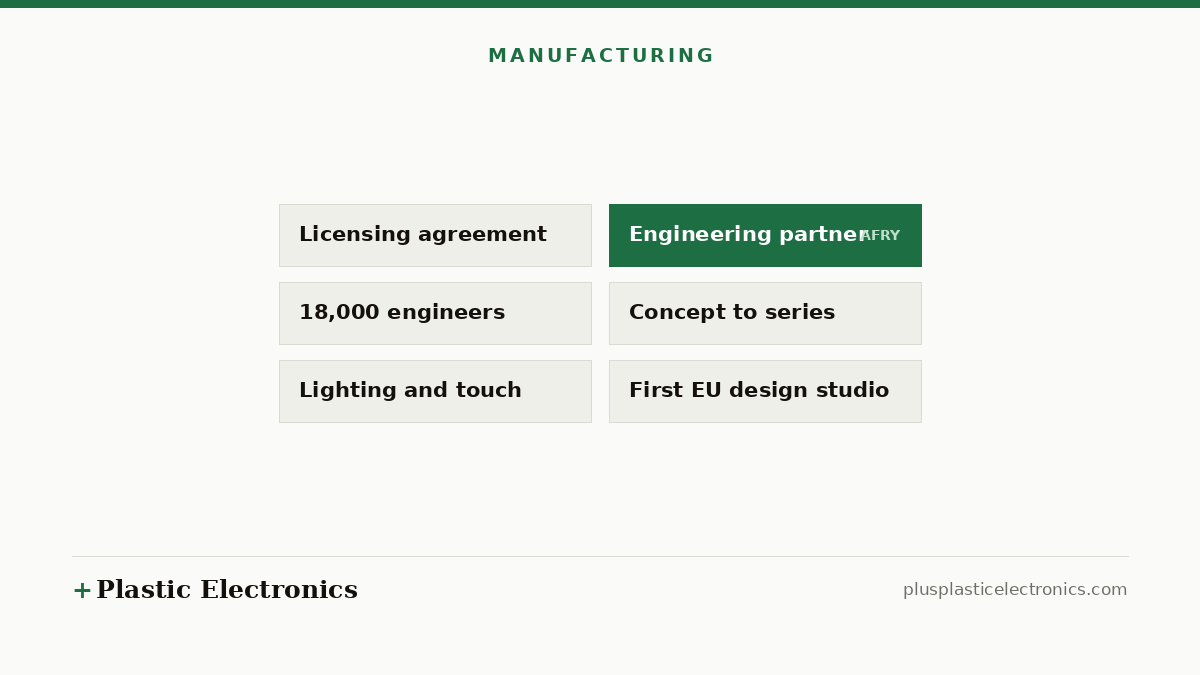
AFRY, the Swedish engineering and design consultancy, has signed a technology licensing agreement with Finland’s TactoTek and joined its In-Mold Structural Electronics (IMSE) ecosystem as an engineering partner. The agreement was announced on 8 September from Oulu and Gothenburg. AFRY will apply IMSE across automotive and mobility programmes, from concept through to series production.
What IMSE is
IMSE integrates lighting, touch controls, electrical components and circuitry into moulded three-dimensional plastic structures, replacing assemblies of separate parts. TactoTek cites lighter designs, less assembly complexity and lower total system cost, and says leading automakers have awarded mass-production programmes using the technology. We have covered the production side of the technology in our report on in-mould electronics in production trim.
What AFRY brings
TactoTek’s announcement describes AFRY as offering complete product and vehicle development, industrial design, embedded software and digital engineering, with 18,000 engineers worldwide. It says the agreement gives IMSE its first European design studio. Under the arrangement, TactoTek supplies the licensing framework and the core structural electronics architecture, while AFRY provides industrial design, digital engineering and embedded software integration, according to Auto-Innovations, which reported the partnership on 9 September.
“IMSE technology aligns well with automotive industry direction toward seamless integration and efficient materials use,” said Martin Andersson, director and head of PSE/Experience Studios at AFRY.
The announcement positions AFRY across the whole development cycle rather than as a one-off design supplier. According to TactoTek, AFRY will integrate IMSE-based smart surfaces into vehicle programmes from concept through to series production, and its services span vehicle development as well as embedded software. That breadth matters because an IMSE part combines electronics, lighting optics and mechanical design, and the software that drives its touch sensing and illumination has to be developed alongside the moulded structure rather than added afterwards.
Why an engineering partner matters
Structural electronics has a design problem as much as a manufacturing one. The circuitry, the moulded part and the surface a driver touches have to be designed together from the start. An IMSE part cannot easily be dropped into a vehicle programme after a conventional button panel has already been specified. Licensing moulders and suppliers builds production capacity. An engineering consultancy that works alongside carmakers’ design teams tackles an earlier bottleneck: getting the technology specified in the first place.
What the announcement does not include is any customer programme, vehicle or volume tied to AFRY’s work, or any financial terms. Auto-Innovations’ report contains no quantified claims beyond the partnership itself, and the sustainability and cost benefits cited are TactoTek’s own.
What we’re watching
- The first vehicle programme in which AFRY’s IMSE design work is named.
- Whether other engineering consultancies follow AFRY into structural electronics.
- Independent evidence from a production programme on the cost and weight savings TactoTek claims.