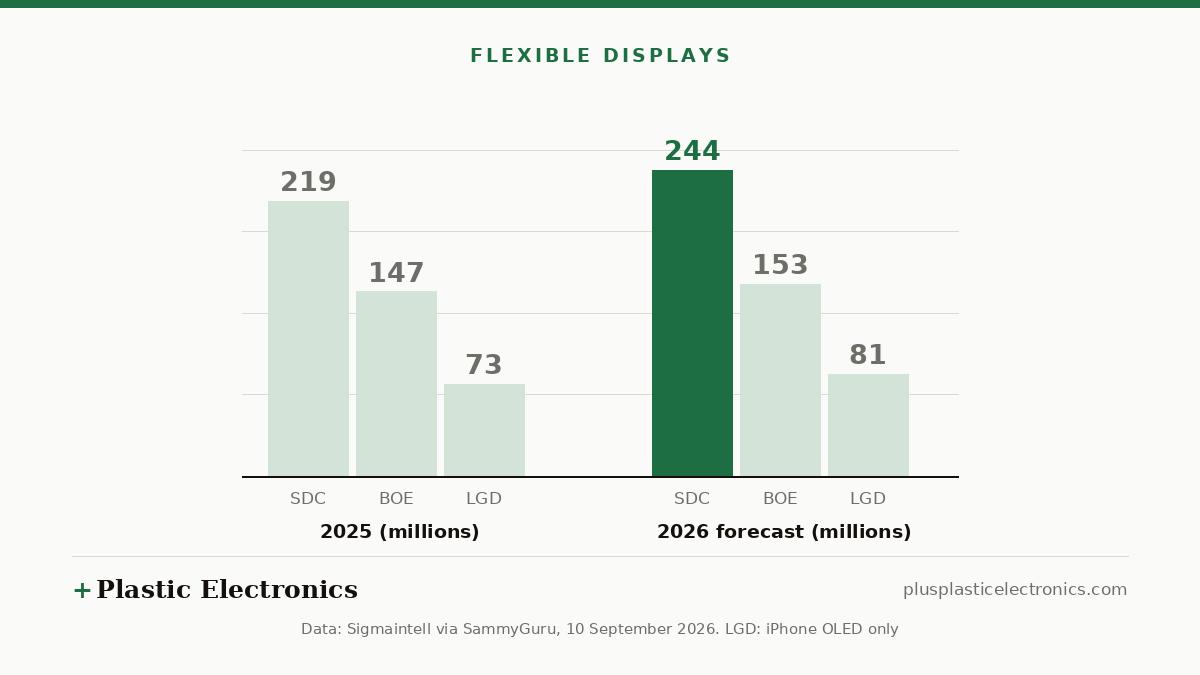
Samsung Display will ship 244 million smartphone flexible OLED panels in 2026, up 11% from 219 million in 2025, according to a forecast from market research firm Sigmaintell reported by SammyGuru on 10 September. The forecast was presented at Sigmaintell’s 9 September conference in Pangyo, South Korea. The same forecast shows the overall market barely moving: Sigmaintell expects global smartphone flexible OLED shipments of 696 million units in 2026, against 694 million in 2025.
Share is shifting, not the market growing
A flat market in which the leader grows 11% means share is moving. Sigmaintell forecasts that BOE will ship 153 million flexible OLED panels this year, up from 147 million, and that LG Display’s iPhone OLED shipments will rise from 73 million to 81 million units. On these figures, the three companies add about 39 million units between them while the market grows by 2 million. LG Display’s figure covers iPhone panels only, so the comparison is approximate, but the direction is clear: the largest suppliers are gaining at other panel makers’ expense.
SammyGuru gives Samsung Display’s split as 117 million panels in the first half of 2026 and 126 million in the second, which sums to 243 million rather than 244 million, presumably through rounding.
That first-half number differs from earlier Sigmaintell data. Reporting on 22 August, tbreak cited Sigmaintell figures showing Samsung Display shipped approximately 120 million flexible OLED smartphone panels in the first half, up 34.5% from 89.2 million, and accounting for 65% of global flexible OLED shipment growth. The gap may reflect different definitions or a revision, and neither report explains it.
The Apple effect
tbreak quotes Sigmaintell attributing Samsung Display’s first-half growth to “strong Apple demand and advance inventory building”, and notes that Samsung supplies major components for Apple’s iPhone 18 Pro and its foldable iPhone. Rigid OLED, meanwhile, keeps shrinking: SammyGuru reports that Samsung Display shipped 53 million rigid OLED panels in the first half of 2026, down 36% from 82.8 million a year earlier. tbreak attributes the wider decline in rigid OLED to manufacturers moving to flexible panels, which means rigid capacity is losing its customers even as the flexible market stops growing.
Why it matters
For materials and equipment suppliers, a stalled unit market changes the growth story. Growth in smartphone flexible OLED now depends on winning share or on more content per device, such as foldables, larger panels and tandem stacks, rather than on the market expanding. The forecast also points to concentration among the largest suppliers, which tends to concentrate purchasing power. Our flexible OLED market outlook sets the longer-range picture.
What we’re watching
- How Sigmaintell reconciles the 117 million and 120 million first-half figures for Samsung Display.
- Second-half shipments tied to Apple’s first foldable iPhone.
- Which panel makers lose share in a market that is no longer growing.